The Brain Trust.
Five lenses. Five models. One verdict.
Built for leaders who make high-stakes decisions without a board.
If you're a founder, CEO, COO, or managing partner — running something real with real financial exposure — this is for you. The Brain Trust is not a research tool or a chatbot. It's a structured council for decisions where getting it wrong costs more than getting advice would.
Where leaders use it
- Hiring — senior leaders and key hires with six-figure annual cost exposure
- Client & pricing strategy — high-risk engagements, rate restructuring, exits
- Partnerships — alliances, subcontracting, referral arrangements
- Growth — new geography, new vertical, headcount expansion
- Technology investments — platforms and infrastructure with multi-year cost exposure
Is this decision worth a Brain Trust council?
Six quick questions. No email required. You'll get a straight read on whether your decision is the kind the Brain Trust is built for — or one you can make on your own.
Answer all six to see your read.
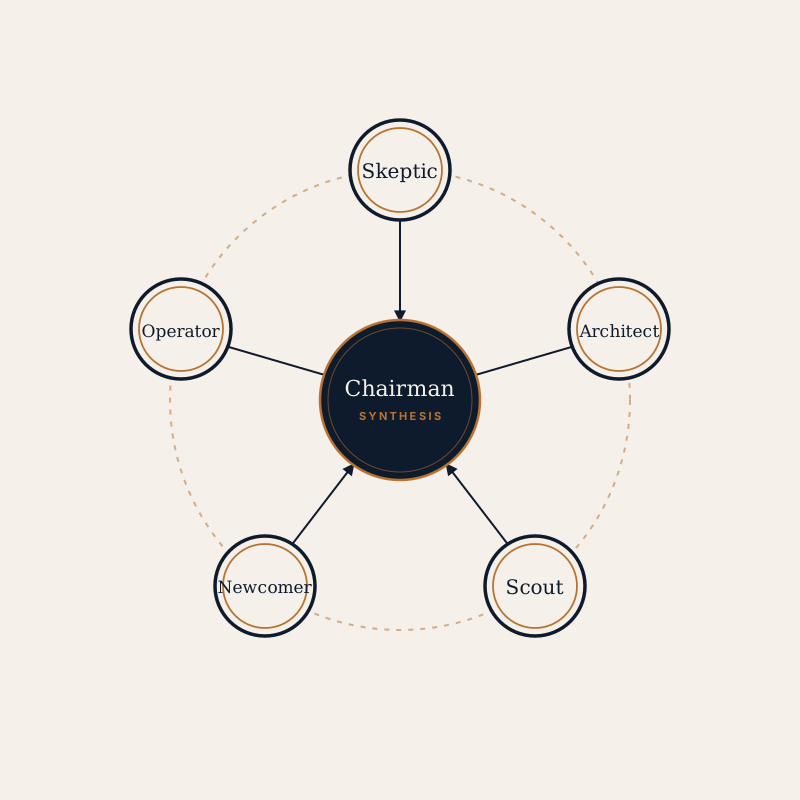
Five AI advisors. Five different thinking lenses. Five different AI models, deliberately chosen so no single model's bias dominates. Each advisor analyzes the question independently, then peer-reviews the others' work anonymously. A Chairman synthesizes everything into one direct verdict — naming where the advisors agree, where they clash, what to actually do, and what would tell you the assumption broke.
Analyze independently
Each advisor takes the question on its own, on a different model.
Peer review
Advisors review each other's work anonymously — no anchoring.
Synthesize the verdict
Chairman names the call, the cost of being wrong, and the kill triggers.
Analyze independently
Each advisor takes the question on its own, on a different model.
Peer review
Advisors review each other's work anonymously — no anchoring.
Synthesize the verdict
Chairman names the call, the cost of being wrong, and the kill triggers.
Analyze independently
Each advisor takes the question on its own, on a different model.
Peer review
Advisors review each other's work anonymously — no anchoring.
Synthesize the verdict
Chairman names the call, the cost of being wrong, and the kill triggers.
Five trusted advisors. Five different ways of looking at your question.
So the obvious answer gets tested before you trust it.
The Skeptic
What's wrong? What's missing? What will fail?
Assumes a fatal flaw exists and hunts for it. Names the specific mechanism of failure — not just the worry. If the plan breaks, the Skeptic tells you exactly where and how.
Most decisions die from one specific failure mode the room didn't want to look at. The Skeptic looks.
The Architect
What are the load-bearing assumptions in this question?
Names the foundations holding up the question itself. Tests each one. Empowered to say "the real question is X" when the question as asked is the wrong one. Rebuilds from what survives.
Sometimes the answer to a hard question is "you're asking the wrong question." The Architect catches that before the work goes sideways.

The Scout
What upside is everyone missing?
Looks for the adjacent opportunity hiding behind the question. What could be bigger than the framing suggests? Required to name the evidence that would validate the upside, not just assert it.
Risk gets all the airtime in most rooms. The Scout makes sure the bigger possibility on the other side gets seen.
The Newcomer
Fresh eyes, informed expertise.
Reads the question as if for the first time. Brings domain knowledge but explicitly not the situational history of this specific decision. Asks what an outside expert would ask — the things the inside team stopped asking three months ago.
Familiarity blinds. The Newcomer surfaces what's become invisible to everyone who's lived with the question.

The Operator
Can it be done? What's the fastest path?
Assumes a decision has been made and produces the operational plan. Doesn't debate; executes on paper. Names reversible steps, hold points, kill triggers, and Monday-morning starting moves.
A great decision with no execution path is a great decision that never happens. The Operator closes the gap from idea to action.
The Chairman.
Final synthesis. After the five advisors have analyzed and peer-reviewed, the Chairman names three things alongside the verdict itself.
Cost of being wrong.
If the recommended path is wrong, what's the actual damage — dollars, time, reputation, optionality?
Reversibility.
Can the recommendation be undone? At what cost?
Kill triggers.
What specific signals would tell you to abort or pivot?
A verdict without a reversibility profile and kill triggers is a guess wearing a confident voice. The Chairman makes sure the synthesis is actionable AND falsifiable.
Three things to notice about this approach.
Five lenses, five models.
Each advisor runs on a different AI model family. Deliberate — same-model councils amplify shared bias instead of stress-testing it.
Anonymous peer review.
Each advisor reviews the others' work without knowing who wrote what. No deference to seniority, no anchoring on the loudest voice.
One direct verdict.
The Chairman doesn't hedge. The synthesis is a clear recommendation with named conditions for being wrong.
What it looks like in practice
A recent council ran on 273 research items in a single session. Five advisors, two rounds, Chairman synthesis. Wall time: 3.5 hours. The cross-model lineup caught what no single model would have — Gemini surfaced upside the Anthropic advisors were too conservative on; Anthropic was sharper on structural risk; OpenAI caught a data-quality issue the others deprioritized.
None of them were right alone. The council was right where any single model wasn't.
Pricing
| Single session | Monthly — 2/mo | |
|---|---|---|
| Executive | $1,500 | $2,500/mo |
Most clients start with a single session. The case for monthly usually becomes obvious after the first one. Typical turnaround: 24–48 hours from intake to written verdict.
If a decision carries $100k+ in exposure, the council pays for itself if it changes the outcome even 2% of the time. Most decisions in scope carry $200k–$1M+.
“Most high-stakes decisions get one opinion, one perspective, one lens — and a confidence the answer is right. The Brain Trust gives you five, peer-reviewed, synthesized into a verdict that names what would prove it wrong. That's a different kind of confidence.
”
Start with a 15-minute intro to see if we're a fit, or jump straight into a working conversation on a specific decision.